1 day ago
Sunday, October 3, 2010
This blog has moved to it's new home...
Well I finally made the intended move - I have moved the blog to my domain at www.uncledutchfarms.com. All comments have been closed, so please update your bookmarks :)

Friday, October 1, 2010
And she's back!
Well yes I know it has been just MONTHS since I posted but I have some very very good news. A lot has happened in the last few months, the most significant of which is that my husband has gotten a job which allows me to be a stay-home mom. It wasn't the job up by our property, we actually had to relocate to the Seattle area, but it is definitely a step in the right direction! We moved at the beginning of September and have been staying at my parents house until our new home is ready.
We managed to find, by the grace of God, a house that is perfect. It's about an hour's drive away, but Tommy avoids most of the rush-hour and it's right outside a town that has less than 700 people. We share some acreage with the owner of the rental who will be our neighbor. There's lots of fruit trees, cane fruits, and tons of wild foraging for mushrooms and berries. It's kind of in the "rain forest" of Washington and so I think I'll have to be on the lookout for sparkly vampires, lol ;) It's also big enough that we can have another baby next year and still have an office (and the master bedroom has one of those BIG bathtubs!).
But I am really excited to start this new endeavor. Even though we're still kind of treading water here in this house, not really unpacking our stuff (and my only cooking devices are an electric skillet and a convection microwave), I've been able to make some good headway with the girls and I am absolutely just loving the simple pleasures of being able to do laundry as it gets dirty, not as I have time and constantly being behind. My kitchen gets cleaned daily instead of twice a week. My kids are happier and the girls really are becoming a lot closer now that they spend more time together. They are learning better habits than what we had energy to enforce when I was working... and the list goes on. I'm more active and I am eating better.
And I haven't even had a chance to do much homesteady stuff! Although I did decently yesterday making a pizza crust without a recipe, bowl, or mixer. Kind of a "dump" it all on the counter and knead it together" deal. I just can't wait until I can start baking our bread again, cooking up pasta sauce and chili to can into quarts, and all the gardening potential of the new house can't be beat! Granted, I probably won't have much luck growing peppers there, but our new landlords pretty much give us carte blanche with the place as long as it makes it look nicer.
Anyway, the other half of why I hadn't been posting is just because my laptop had died and our ancient desktop is so slow it takes several minutes for webpages to load... it's mostly good for checking facebook and email and that's it. But now that I got my laptop back (thanks to the best big brother ever!) I should be able to post a lot more regularly than I ever have.
We managed to find, by the grace of God, a house that is perfect. It's about an hour's drive away, but Tommy avoids most of the rush-hour and it's right outside a town that has less than 700 people. We share some acreage with the owner of the rental who will be our neighbor. There's lots of fruit trees, cane fruits, and tons of wild foraging for mushrooms and berries. It's kind of in the "rain forest" of Washington and so I think I'll have to be on the lookout for sparkly vampires, lol ;) It's also big enough that we can have another baby next year and still have an office (and the master bedroom has one of those BIG bathtubs!).
But I am really excited to start this new endeavor. Even though we're still kind of treading water here in this house, not really unpacking our stuff (and my only cooking devices are an electric skillet and a convection microwave), I've been able to make some good headway with the girls and I am absolutely just loving the simple pleasures of being able to do laundry as it gets dirty, not as I have time and constantly being behind. My kitchen gets cleaned daily instead of twice a week. My kids are happier and the girls really are becoming a lot closer now that they spend more time together. They are learning better habits than what we had energy to enforce when I was working... and the list goes on. I'm more active and I am eating better.
And I haven't even had a chance to do much homesteady stuff! Although I did decently yesterday making a pizza crust without a recipe, bowl, or mixer. Kind of a "dump" it all on the counter and knead it together" deal. I just can't wait until I can start baking our bread again, cooking up pasta sauce and chili to can into quarts, and all the gardening potential of the new house can't be beat! Granted, I probably won't have much luck growing peppers there, but our new landlords pretty much give us carte blanche with the place as long as it makes it look nicer.
Anyway, the other half of why I hadn't been posting is just because my laptop had died and our ancient desktop is so slow it takes several minutes for webpages to load... it's mostly good for checking facebook and email and that's it. But now that I got my laptop back (thanks to the best big brother ever!) I should be able to post a lot more regularly than I ever have.
Sunday, May 16, 2010
Planted tomatoes & peppers
So actually before I go in to what I planted today I have to say... I have been in a conundrum. what's a girl to do when she wants to garden but will be moving in the middle of the summer?
grow in containers! :)
 So what i ended up doing this afternoon was loads of back breaking work. I am exhausted! I filled tons of containers I got from my Mom and planted tomatoes and lots of peppers.
 Here you can see a few of them. I can't remember what's what, but those are mostly peppers and the small one is an old dried up petunia, I'm not sure if it will live.
 Here's my tomatoes. And yes I had to fill the containers, plant the maters, and then I dug holes in the beds and put the containers in. In my theorizing this will help them from getting too dried out (plus I'll mulch too) and then I can utilize my fancy shmanzy irrigation system that I put in. You can see the lines going over the maters. This way when I move, I can just pull them out.
 Here is my only fully planted bed. On the far side I've got 3 different types of onions, then I have some carrots. I did have radishes but they weren't bulbing out so I pulled them and just stuck the peppers in there. All those are peppers. And way to go me for recycling - the white containers on the far right are milk jugs with the tops cut off.
 And just for fun, here's one of my shady beds, you can see the peas growing in the little patch I planted. Also you can see the lone BROCCOLI which is what I thought initially was some sort of weird lettuce.
 Here's my Borage that I direct seeded. I dug one of them up and put it in a container next to my strawberries and potatoes.
 And here's my happily mulched strawberries and a few surviving runners in the black container. Those will go up to my parents' place.
 Some more of my starts!Most of these are my melons, cucumbers and pumpkins. I don't know how many of those I will plant, but many of them will probably end up at my parents' place too. On the right there are two raspberry starts that I dug up from my friend's house. I have someone mailing me some salmonberry starts too, so we'll see if those survive!
 And here is some of my other plants. Some leftover peppers & maters that I'll plant at my parents' place and you can see the grape cuttings in the back out for some sunshine.
 My tropicals! They are growing like crazy.
 Except my pepper vine has mites! I'm going to try smoking them out tonight and see how that goes. I'm pretty sure the mites were on it when it got here.
 My vanilla orchid is growing! That green shoot at the top is brand new.
 And here's one of the first citrus trees that I got - allll of that is new growth. Crazy huh! It's also setting bud for another flower... I had pulled off all the flowers when I got it because I wanted it to establish first for about 6 months but apparently it's pretty happy :)
grow in containers! :)
 So what i ended up doing this afternoon was loads of back breaking work. I am exhausted! I filled tons of containers I got from my Mom and planted tomatoes and lots of peppers.
 Here you can see a few of them. I can't remember what's what, but those are mostly peppers and the small one is an old dried up petunia, I'm not sure if it will live.
 Here's my tomatoes. And yes I had to fill the containers, plant the maters, and then I dug holes in the beds and put the containers in. In my theorizing this will help them from getting too dried out (plus I'll mulch too) and then I can utilize my fancy shmanzy irrigation system that I put in. You can see the lines going over the maters. This way when I move, I can just pull them out.
 Here is my only fully planted bed. On the far side I've got 3 different types of onions, then I have some carrots. I did have radishes but they weren't bulbing out so I pulled them and just stuck the peppers in there. All those are peppers. And way to go me for recycling - the white containers on the far right are milk jugs with the tops cut off.
  And just for fun, here's one of my shady beds, you can see the peas growing in the little patch I planted. Also you can see the lone BROCCOLI which is what I thought initially was some sort of weird lettuce.
 Here's my Borage that I direct seeded. I dug one of them up and put it in a container next to my strawberries and potatoes.
 And here's my happily mulched strawberries and a few surviving runners in the black container. Those will go up to my parents' place.
 Some more of my starts!Most of these are my melons, cucumbers and pumpkins. I don't know how many of those I will plant, but many of them will probably end up at my parents' place too. On the right there are two raspberry starts that I dug up from my friend's house. I have someone mailing me some salmonberry starts too, so we'll see if those survive!
 And here is some of my other plants. Some leftover peppers & maters that I'll plant at my parents' place and you can see the grape cuttings in the back out for some sunshine.
 My tropicals! They are growing like crazy.
 Except my pepper vine has mites! I'm going to try smoking them out tonight and see how that goes. I'm pretty sure the mites were on it when it got here.
 My vanilla orchid is growing! That green shoot at the top is brand new.
 And here's one of the first citrus trees that I got - allll of that is new growth. Crazy huh! It's also setting bud for another flower... I had pulled off all the flowers when I got it because I wanted it to establish first for about 6 months but apparently it's pretty happy :)
Sunday, April 25, 2010
Garden & Kids 4/25
 Well you know me, I like to post pics. No real news here, just some pictures from this afternoon.
 Here's a volunteer, some sort of mint. I didn't grow any mint and there was none growing here when we moved here 2 years ago. There are two plants... I wonder if seeds got dropped by some birds? I'm tempted to dig it up because I know how invasive the stuff can be.
 Another volunteer... some chives going to seed. These have been here for many years, I dug them out of the strawberry planter and then was not intending to save them, so I threw them upside down into the walkway of the garden and ignored them. They must have hibernated last year and then they came up this year with shining colors :)
 I think it's some sort of cabbage but it also volunteered this year. Maybe a lettuce? Anybody have any idea?
 Eleora digging up dirt in the garden.
 Sophia playing with the play house. If you happen to notice the dirt around her mouth it's because I was mixing up some soil blocker mix and she must have thought it looked tasty because as soon as I turned my head she grabbed a handful and stuck it in her mouth. A lil dirt never killed anyone, right? lol... you should have seen her face, it was priceless.
 Pictures of all my 5 trees happily in the corner. OH YEAH I FORGOT TO MENTION... lol. Silly ol me decided to go back to Home Depot yesterday to get the Bearss Lime and the Blood Orange trees. I just couldn't resist. Many people have problems with impulse buying but I tend to do the opposite and NOT buy things when I really should. These trees are such great quality and an excellent buy for $15 so I decided I'd get all 5 types that had caught my eye. They did also have 2 other kinds but not ones I was interested in, so now I have one of each tree that I had liked - Satsuma Mandarin, Navel orange, blood orange, Meyer lemon, and Bearss Lime (plus the two key limes I'm sprouting and all the other stuff).
Some kids suck their thumbs... Sophia does this. I don't know where she got it from but she holds her blanket like that all the time, it's funny :)
And that's all I got for the day! Just had to share :)
Thursday, April 22, 2010
My new obsession - tropicals!
Ok so here's the deal. I have this thing about the supply chain... basically, it's not infallible. Things could happen. And with our economy, who knows what could happen?
And here's practical little me saying - zomg if the food chain was interrupted how would I get MANGOS or AVOCADOS??? LEMONS AND LIMES???
This thought has been ricocheting around in my brain for about a year now so gradually I have started researching growing tropical plants. Not that I really think I'd have a big crop, but hey, if bananas or pineapples were expensive or impossible to get I think it would be nice to have them once in a while. Plus, it's just COOL to grow tropicals indoors.
So here's my little collection so far! I am very proud of each of my pieces. I don't know if I will ever get fruit or anything but it is FUN to have them, I love it.
 Here's a couple that are really fun! I won't get anything out of them until someday when I have a good-size greenhouse, though, but it's still a novelty. The vine on the left is a vanilla orchid. The flowers bloom for ONE DAY only and need to be hand-pollinated in order to grow a bean. Oh yeah, and it needs like 40 feet of length in order to be mature enough to flower. That's why I need a greenhouse :)
 The one on the right is Piper Nigrum AKA black pepper. Somewhat easy to grow from what I've heard but also one that needs a LOT of room to climb. It's a vine so I'll basically need to get a greenhouse with a really big looping trellis. The berries grow in little clusters. What we know as black peppercorns are actually the immature green peppercorns dried. You can also make white pepper by allowing the berries to mature and removing the outer shell. Either way, they are very potent, way moreso than the black peppercorns you can buy so I am really hoping I can try them! Something a lot of people do is just crush the green berries right off the plant and use them. Lots of experimenting potential... if I just happened to have a huge greenhouse with lots of room for this vine to roam, that is ;)
 Here are two of my citrus trees. I just got them a few weeks ago when I went to Home Depot with my mom and happened to naturally sorta gravitate towards the plant section. What did I see but not only a Meyer Lemon for $14.95 but also a SATSUMA mandarin! I was having a hard time finding them, and mail-order it would be hard to beat finding 4 foot trees in such great condition for only 15 bucks! So I got the two...
 ... and then the other day I went back and got another - a navel orange. The last one they had, too! Isn't it beautiful? Just $15, too... a steal considering what I'd pay for a tree like that shipped to me. The first two had already put on new growth in the week they were at my house so I decided to get this one. They had a few other citrus trees but those were the main ones I wanted. I might still go back for a blood orange, though, that one looked cool, but I'm running out of room on the ONE window I can keep them by :)
 And this one doesn't technically count as a tropical but I forgot to blog it earlier with my starts :) These are my grape cuttings that I got earlier this year. I got 5 Thompson Seedless, about 20 Concord, and 4 each of two different wine grapes, Chardonel and one other I can't remember.
Anyway, I completely did them wrong (the Thompson and Concord, that is) so I am not expecting much of a turnout but you can see I do have SOME! The big leaf you see is the Chardonel wine grape (thanks, Gary!) and the one right behind it right on the vermiculite is a Concord (and there's one more Concord putting out a leaf but you can't see it in this pic). I know some more of the starts are still alive so I guess we'll see what the turnout is like once it's time to plant them. I hope Papa gets his tractor ready! Hopefully we'll have quite a few to plant.
Oh and honorable mentions that don't have a photo - I currently have a pineapple that is trying really hard to grow roots and two germinated key lime seeds that I have planted. Key limes do grow true to seed so I'm hoping to get some trees, although I could just swing by Home Depot and get a 4 foot lime tree for 15 bucks! lol... I am terrible. I got a choice of $50 gift card from work when I won a drawing and what did I choose? Home Depot so I could get gardening and irrigation supplies... haha I am such a nerd. Oh well. I still have about $18 left, so I could probably go get another tree. Just no place to put it.
Oh and I also have some ginger, two pots of it but no sprouts yet, those are just recently planted.
So, not bad, right? :)
And here's practical little me saying - zomg if the food chain was interrupted how would I get MANGOS or AVOCADOS??? LEMONS AND LIMES???
This thought has been ricocheting around in my brain for about a year now so gradually I have started researching growing tropical plants. Not that I really think I'd have a big crop, but hey, if bananas or pineapples were expensive or impossible to get I think it would be nice to have them once in a while. Plus, it's just COOL to grow tropicals indoors.
So here's my little collection so far! I am very proud of each of my pieces. I don't know if I will ever get fruit or anything but it is FUN to have them, I love it.
 Here's a couple that are really fun! I won't get anything out of them until someday when I have a good-size greenhouse, though, but it's still a novelty. The vine on the left is a vanilla orchid. The flowers bloom for ONE DAY only and need to be hand-pollinated in order to grow a bean. Oh yeah, and it needs like 40 feet of length in order to be mature enough to flower. That's why I need a greenhouse :)
 The one on the right is Piper Nigrum AKA black pepper. Somewhat easy to grow from what I've heard but also one that needs a LOT of room to climb. It's a vine so I'll basically need to get a greenhouse with a really big looping trellis. The berries grow in little clusters. What we know as black peppercorns are actually the immature green peppercorns dried. You can also make white pepper by allowing the berries to mature and removing the outer shell. Either way, they are very potent, way moreso than the black peppercorns you can buy so I am really hoping I can try them! Something a lot of people do is just crush the green berries right off the plant and use them. Lots of experimenting potential... if I just happened to have a huge greenhouse with lots of room for this vine to roam, that is ;)
 Here are two of my citrus trees. I just got them a few weeks ago when I went to Home Depot with my mom and happened to naturally sorta gravitate towards the plant section. What did I see but not only a Meyer Lemon for $14.95 but also a SATSUMA mandarin! I was having a hard time finding them, and mail-order it would be hard to beat finding 4 foot trees in such great condition for only 15 bucks! So I got the two...
 ... and then the other day I went back and got another - a navel orange. The last one they had, too! Isn't it beautiful? Just $15, too... a steal considering what I'd pay for a tree like that shipped to me. The first two had already put on new growth in the week they were at my house so I decided to get this one. They had a few other citrus trees but those were the main ones I wanted. I might still go back for a blood orange, though, that one looked cool, but I'm running out of room on the ONE window I can keep them by :)
 And this one doesn't technically count as a tropical but I forgot to blog it earlier with my starts :) These are my grape cuttings that I got earlier this year. I got 5 Thompson Seedless, about 20 Concord, and 4 each of two different wine grapes, Chardonel and one other I can't remember.
Anyway, I completely did them wrong (the Thompson and Concord, that is) so I am not expecting much of a turnout but you can see I do have SOME! The big leaf you see is the Chardonel wine grape (thanks, Gary!) and the one right behind it right on the vermiculite is a Concord (and there's one more Concord putting out a leaf but you can't see it in this pic). I know some more of the starts are still alive so I guess we'll see what the turnout is like once it's time to plant them. I hope Papa gets his tractor ready! Hopefully we'll have quite a few to plant.
Oh and honorable mentions that don't have a photo - I currently have a pineapple that is trying really hard to grow roots and two germinated key lime seeds that I have planted. Key limes do grow true to seed so I'm hoping to get some trees, although I could just swing by Home Depot and get a 4 foot lime tree for 15 bucks! lol... I am terrible. I got a choice of $50 gift card from work when I won a drawing and what did I choose? Home Depot so I could get gardening and irrigation supplies... haha I am such a nerd. Oh well. I still have about $18 left, so I could probably go get another tree. Just no place to put it.
Oh and I also have some ginger, two pots of it but no sprouts yet, those are just recently planted.
So, not bad, right? :)
Cheep Cheep!
 Last weekend we had planned a trip up on Saturday to the property to go visit Grammie and Papa. As you remember, I had spent the afternoon the week before with my mom building a chicken tractor of sorts for her new chicks. She only got a few at the time and so suggested that I take the girls to the feed store that's right down the street and get some more chicks, since they were supposed to get some sexed laying pullets in.
Sophia was pretty sick the night before (I think she threw up more than 10 times in 24 hours!) and so I ended up staying home with her on Friday but then Tommy was there for part of the time too so I took Eleora to the feed store and we picked out some chicks! They were guaranteed 97% female so most likely we got no roosters in the bunch :) Eleora picked out a Barred Rock for hers (Her name is "My Black One") and I had wanted Auracanas and so I picked out one for me (Fluffy) and one for Sophia (Bolt). We also got two Buff Orpingtons (Buffy and Angel) and two Leghorns (Foghorn and Leghorn) and two Rhode Island Reds (Itchy & Scratchy). We got a heat lamp and put out a dish of water for them in a rubbermaid bin. The girl at the feed store was a doll and gave us some extra food since it was Friday and we wouldn't be getting them up to Grammie & Papas house until Saturday... so we got them a little dish of food and some shavings and they were quite comfortable.
Eleora had a blast, of course. Sophia also had lots of fun but she's such a flitterbug that she wasn't as focused... Eleora basically sat next to the chicks all afternoon and then the next morning.
On Saturday the chicks got to ride up between the two carseats in their little rubbermaid bin and so that was some nice extra entertainment for the girls. When we got there, we put them into the cage with the other chicks and they fit right in!
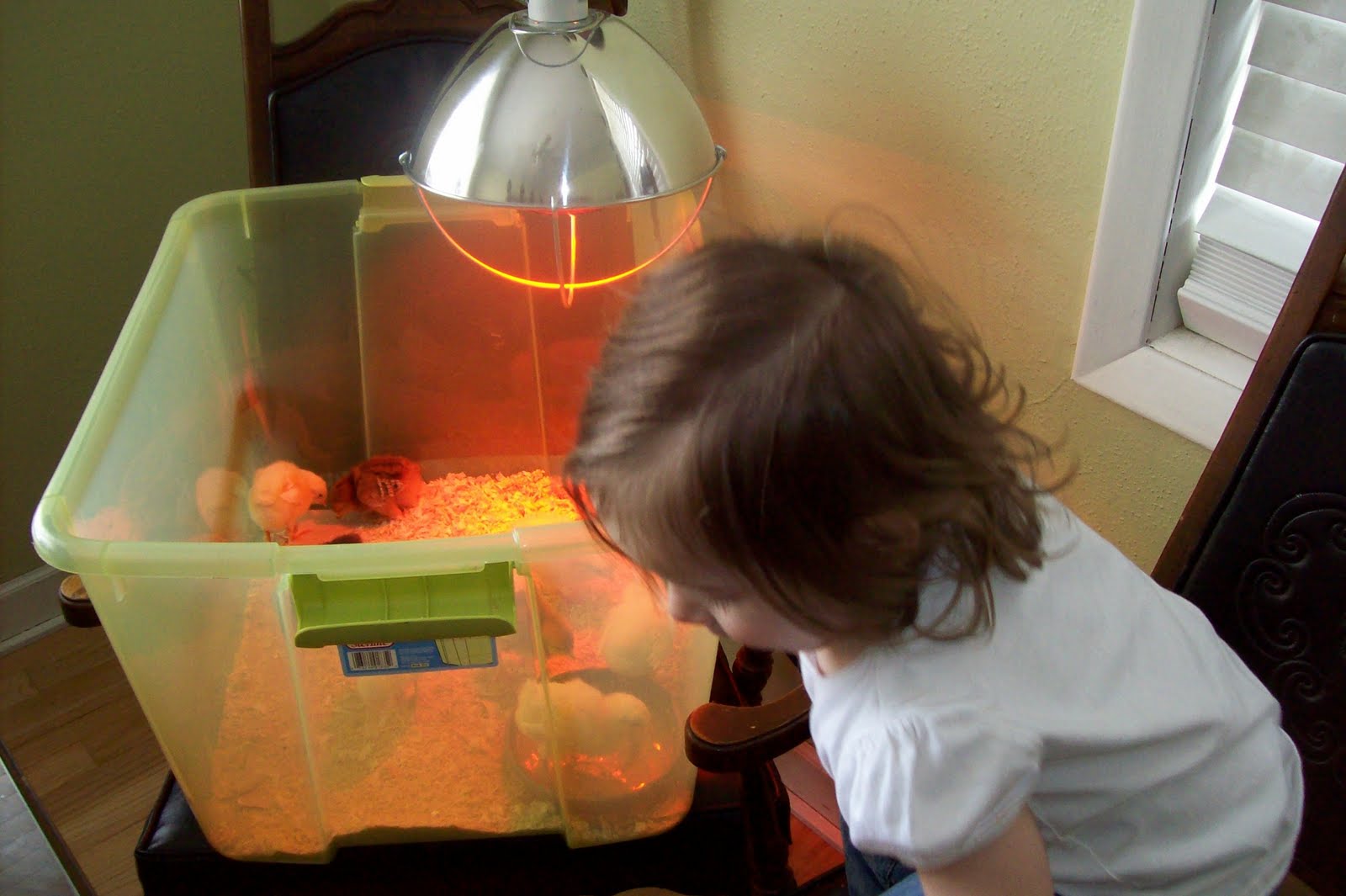 Sophia's investigating...
 My girls and their chicks!
 Eleora loves "My Black One"
 This is what she did... for hours. Talk about focus!
 Ahh she was finally brave enough to hold My Black One on her lap!
 Look at me!
And just because it was so pitiful and cute, this is what I came home to on Thursday. Sophia had already thrown up about 5 times, so he finally just stripped her naked (since he kept changing her clothes) and laid her on him and she passed right out... I've never seen her do that. Poor thing! She woke up later and did the same thing with me for a few hours also up into about 5am Friday morning.

But by Friday night she was feeling like her saucy little self!

4" soil blocker
OK so I finally got to put the 4" soil blocker that Tommy made me to the test. Best illustrated with pictures, of course.
 Here's the blocker. It's an 8 inch length of 4" PVC pipe with some sort of end cap that happens to fit perfectly right inside it. There's a u-shaped bolt that forms a handle and then the nuts that it attaches to on the bottom form sort of "dibbles" for the seeds, 2 per block.

So basically I hold the cap in place, flip the blocker upside down and fill it loosely with my blocking mix.
 I carefully set it onto a plastic lid that I'm using as a cover just for me to press onto. You could press onto the table directly if you wanted to.

A closer look at the bottom of the lid, you can see the two bolts that are good sized and form a good size dibble on both sides.
 So here is the lid once I have flipped the blocker back on to sit on the plastic lid, I'm getting ready to press.
 Time to press! The handle works great although I will say next one I make will only be 6 inches long (the tube) and I'll just fill it in place... to get a decently compacted block I had to press further than my hand could comfortably reach and so I had to use a towel and a stick to push it in all the way. I think if I made the tube shorter and just filled the whole length with mix I'd end up with the same amount of mix but not so far to press.
 And here it is all compacted!
 I carefully slide the tube upwards, leaving the "plunger" top in place sitting right on top of my compressed soil block.
 Using a spatula, I move the block from the plastic lid to it's permanent home in my seed tray.
 And then once it is in it's home I lift the top off very carefully and voila!

And here's a tray almost filled with the blocks. You can sort of see the two indentations on each side that the bolts made, they are a great size for the bigger seeds you will plant in these like melons, pumpkins, etc.
I got cucumbers and melons planted in these, and I also started some marigolds and basil in some of the 2 inch blocks.
 Speaking of the 2 inch blocks, one thing I wanted to do was to make the bigger block so I could easily pot up a 2inch block into it. But I found that this design didn't work well for that. I had a 2 inch block but I couldn't seem to get the soil mix compacted enough on the sides of the block. I tried doing it in layers which worked a little bit but then it occurred to me - I'm trying to make this simple, right? It was really just too complicated to make it work so I just took the blocker for what it was, ran to the store down the street for some 18oz keg cups, and potted my tomatoes & peppers up into those. They worked perfectly and were way quicker to fill than making 4 inch soil blocks with 2inch square holes in them :)
 Here's the blocker. It's an 8 inch length of 4" PVC pipe with some sort of end cap that happens to fit perfectly right inside it. There's a u-shaped bolt that forms a handle and then the nuts that it attaches to on the bottom form sort of "dibbles" for the seeds, 2 per block.
So basically I hold the cap in place, flip the blocker upside down and fill it loosely with my blocking mix.
 I carefully set it onto a plastic lid that I'm using as a cover just for me to press onto. You could press onto the table directly if you wanted to.
A closer look at the bottom of the lid, you can see the two bolts that are good sized and form a good size dibble on both sides.
 So here is the lid once I have flipped the blocker back on to sit on the plastic lid, I'm getting ready to press.
 Time to press! The handle works great although I will say next one I make will only be 6 inches long (the tube) and I'll just fill it in place... to get a decently compacted block I had to press further than my hand could comfortably reach and so I had to use a towel and a stick to push it in all the way. I think if I made the tube shorter and just filled the whole length with mix I'd end up with the same amount of mix but not so far to press.
 And here it is all compacted!
 I carefully slide the tube upwards, leaving the "plunger" top in place sitting right on top of my compressed soil block.
 Using a spatula, I move the block from the plastic lid to it's permanent home in my seed tray.
 And then once it is in it's home I lift the top off very carefully and voila!
And here's a tray almost filled with the blocks. You can sort of see the two indentations on each side that the bolts made, they are a great size for the bigger seeds you will plant in these like melons, pumpkins, etc.
I got cucumbers and melons planted in these, and I also started some marigolds and basil in some of the 2 inch blocks.
 Speaking of the 2 inch blocks, one thing I wanted to do was to make the bigger block so I could easily pot up a 2inch block into it. But I found that this design didn't work well for that. I had a 2 inch block but I couldn't seem to get the soil mix compacted enough on the sides of the block. I tried doing it in layers which worked a little bit but then it occurred to me - I'm trying to make this simple, right? It was really just too complicated to make it work so I just took the blocker for what it was, ran to the store down the street for some 18oz keg cups, and potted my tomatoes & peppers up into those. They worked perfectly and were way quicker to fill than making 4 inch soil blocks with 2inch square holes in them :)
Subscribe to:
Posts (Atom)